![Ultra-premium editorial magazine cover / collectible poster design featuring [Subject] as the domina](https://images.meigen.ai/cdn-cgi/image/format=auto,quality=85,width=640,fit=scale-down/generations/2026-09/community_ccd6bcbf-b674-48f2-90de-bdb546c786d1.png)
Back to GalleryZ Image Turbo
Prompt
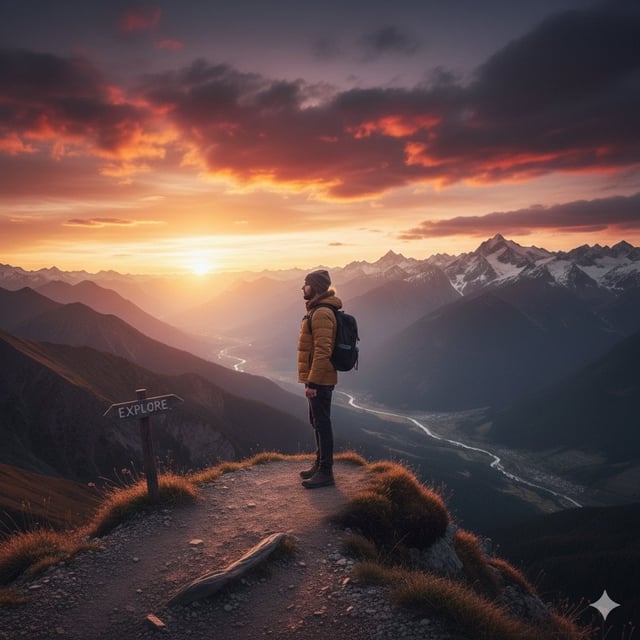
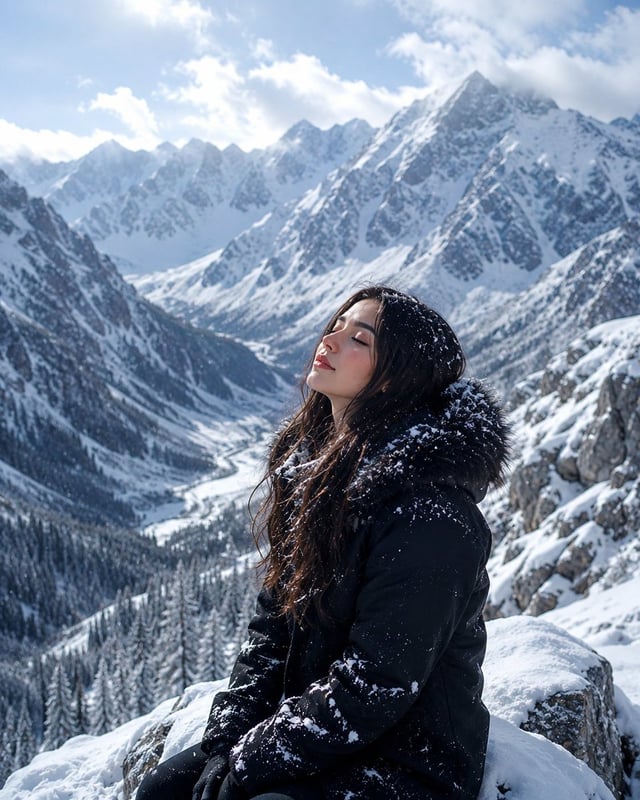
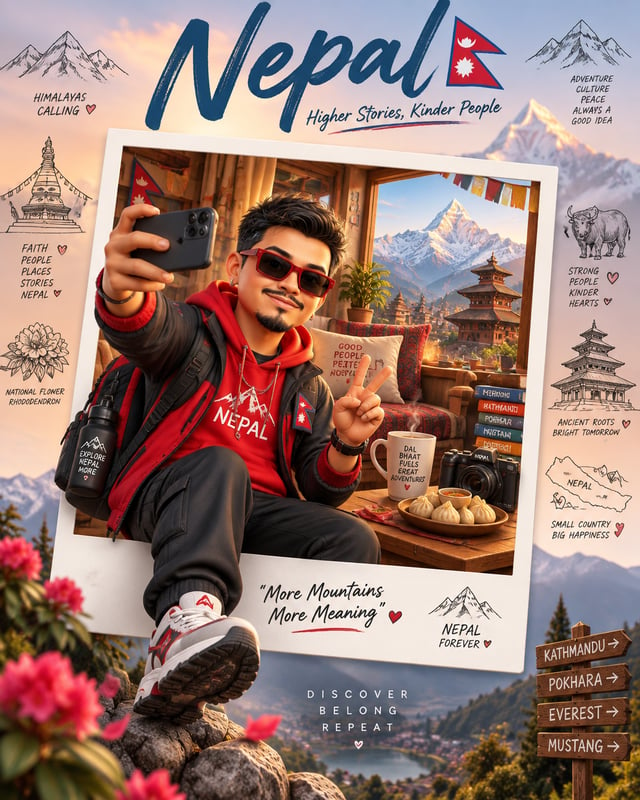
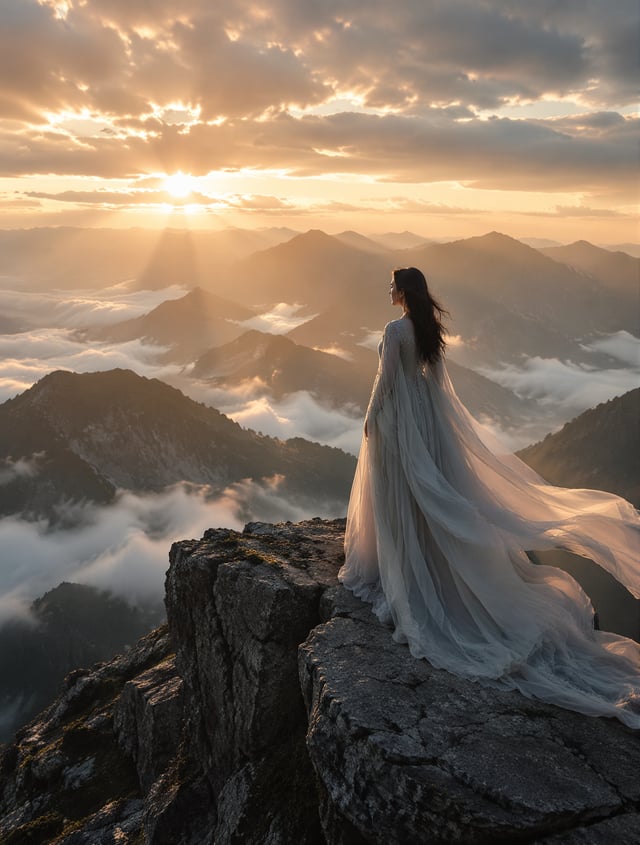
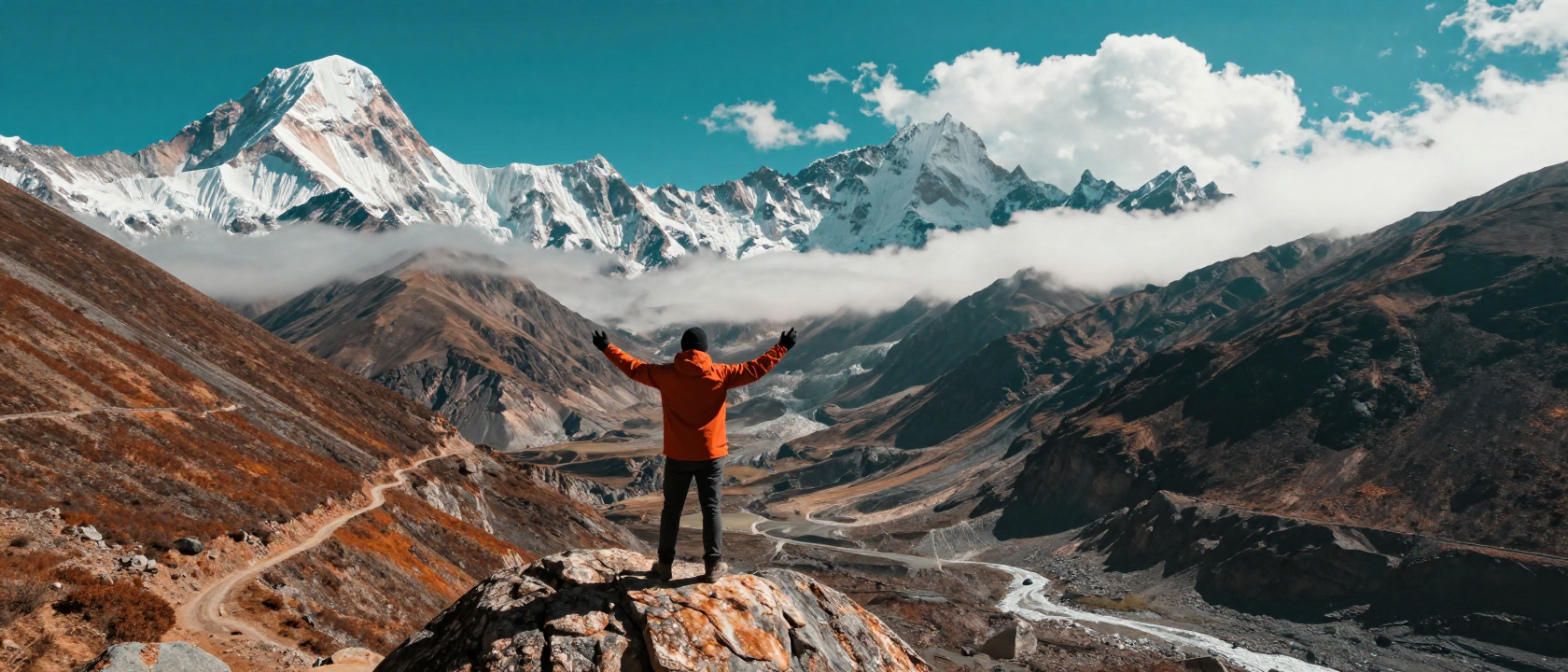
A highly photorealistic cinematic outdoor-adventure photograph rather than an illustration or fantasy painting.Create a dramatic 3:2 horizontal landscape showing exactly one anonymous adult traveler standing on the highest point of a large weathered boulder in the lower-center foreground. The traveler must face completely away from the camera and look toward an immense Himalayan mountain panorama. Position the traveler almost exactly at the horizontal center of the frame, approximately two-thirds of the way down the image. Keep the person relatively small compared with the landscape so the mountains feel monumental and the human figure feels vulnerable, exhilarated and awe-inspired.POSE:The traveler stands upright with both feet close together on the rounded top of the boulder. Extend both arms outward at approximately shoulder height in a broad, open, triumphant gesture. Keep the elbows slightly bent and the hands relaxed, open or subtly turned upward. The posture should communicate freedom, achievement, wonder and surrender to the grandeur of nature. The traveler must have normal human anatomy, exactly two arms, two legs and two hands. Do not show the face.CLOTHING:Dress the traveler in a vivid burnt-orange or red-orange insulated hiking jacket, dark charcoal or navy hiking trousers, black hiking gloves, dark hiking boots and a close-fitting black or dark-gray knitted beanie. Do not include a backpack, trekking poles, climbing harness, helmet or visible logos. The orange jacket should be the strongest warm focal color in the entire image and should contrast clearly with the cool mountain environment.FOREGROUND BOULDER:Place the traveler on a large, exposed, naturally weathered alpine boulder rising from the bottom-center edge of the frame. Give the boulder a broad but irregular rounded summit, rough fractured surfaces, shallow cracks, mineral streaks and detailed gray-brown-rust textures. Crop the lower section of the boulder naturally at the bottom edge so it feels like a projecting rock outcrop above the valley. Keep the boulder sharply detailed and large enough to act as a visual pedestal for the traveler.LANDSCAPE COMPOSITION:Build the landscape around a deep V-shaped alpine valley. A broad reddish-brown slope should descend from the lower-left side toward the central valley, while a steeper, darker and rockier slope should descend from the lower-right side. These two slopes must frame the traveler and converge toward the valley floor behind the person.On the left slope, include dry rust-colored alpine grasses, muted ochre soil, exposed dark rock, pale erosion channels and several narrow winding footpaths. Use these pathways as subtle leading lines directing the eye toward the traveler and into the valley.On the right slope, include steeper scree, angular stones, rugged dark-brown earth, copper-colored vegetation, small gullies and scattered rocks. Make the right slope more shadowed, rugged and enclosed than the left slope.VALLEY FLOOR:Behind the traveler, create a long high-altitude valley receding toward the distant mountains. Include a pale winding glacial stream or braided meltwater channel running through the valley floor. The watercourse should appear silver-gray, pale blue and partially reflective, with an irregular serpentine path that strengthens the sense of depth. Surround it with muted brown, gray, olive and cool teal sediment flats.MOUNTAIN RANGE:Fill the entire middle and upper background with a huge, jagged Himalayan mountain chain resembling Nepal’s Everest-region terrain. The range must feel geologically believable, layered and extremely large.In the upper-left quadrant, place a dominant steep pyramidal mountain with a sharply pointed, slightly serrated summit. Give it dramatic vertical rock faces, snow-covered upper ridges, narrow gullies and alternating planes of white sunlight and blue-cyan shadow. This left peak should be one of the clearest and most sharply defined mountains in the frame.Across the center, continue the skyline with a sequence of overlapping triangular snow peaks, sharp ridges, dark exposed rock faces, narrow saddles and layered mountain shoulders. Vary their height and distance so they do not look repetitive or artificially symmetrical. Preserve a clear sense of atmospheric perspective, with the more distant peaks appearing slightly softer and bluer.In the upper-right quadrant, create a taller and broader snow-covered mountain mass that is partially hidden by thick clouds. Reveal only portions of its summit, ridgelines, glacial surfaces and dark rock faces through openings in the cloud. The partial concealment should create mystery and scale without making the mountain disappear completely.CLOUD STRUCTURE:Add a wide horizontal belt of low white cloud drifting through the middle of the mountain range. This cloud layer should pass in front of the lower mountain faces and above the distant valley, separating the snowy skyline from the terrain below. Make it soft, irregular and naturally fragmented rather than a perfectly straight band.Create a very large billowing cloud mass entering from the upper-right corner. It should wrap around and partially obscure the right mountain. Give the cloud bright white sunlit edges, pale cyan and soft blue interior shadows, dense rounded volumes and feathered outer wisps. Allow part of the cloud to descend toward the center-right valley.Include a few small isolated cloud fragments near the central peaks, while leaving most of the upper-left and upper-center sky open.SKY:Use a broad, clean, high-altitude sky transitioning from deep turquoise at the top to bright cyan closer to the horizon. The sky should be richly saturated but still retain smooth tonal gradients. Keep the clearest blue region above the left and central mountains. Do not show the sun, stars, birds, aircraft or artificial objects.LIGHTING:Use strong, crisp high-altitude daylight coming primarily from the upper-left or front-left. Illuminate the left-facing snow ridges and foreground terrain with bright natural light. Render opposing mountain faces in cool blue-teal shadow. Add luminous highlights to the upper edges of the clouds and soft cyan shadows within their deeper folds.Preserve detail in both bright snow and dark terrain, producing a controlled high-dynamic-range appearance. Do not blow out the clouds or snow. Keep the traveler sufficiently illuminated to show the orange jacket, dark trousers and arm position, while still integrating the figure naturally into the landscape.COLOR GRADING:Apply a sophisticated cinematic teal-and-orange travel-photography grade. Shift the sky, distant shadows and atmospheric haze toward turquoise, cyan and deep teal. Shift the dry vegetation, soil and foreground rocks toward burnt orange, copper, rust and muted ochre. Keep the snow primarily white with cool cyan-blue shadow detail.Make the orange jacket the central color accent. The saturation should be dramatic and polished but not neon or synthetic. Maintain natural material colors beneath the grade.CAMERA AND PERSPECTIVE:Use the visual equivalent of a professional full-frame camera with a 24–28 mm wide-angle lens. Position the camera on a nearby elevated viewpoint, slightly below or approximately level with the traveler’s torso. Preserve natural wide-angle depth without fisheye curvature or severe edge distortion.Use a deep depth of field comparable to f/8 or f/11, keeping the traveler, foreground boulder, valley and major mountain ridges clearly resolved. The most distant mountain layers may be softened slightly by atmospheric haze. Use crisp focus, low visible noise and a fast enough shutter appearance to avoid motion blur.COMPOSITIONAL PRIORITIES:Maintain a strong V-shaped valley.Keep the traveler centered and relatively small.Place the dominant pointed peak in the upper-left.Place the largest cloud mass in the upper-right.Use the foreground boulder as a central pedestal.Use the left and right slopes as natural framing elements.Preserve a large open cyan sky above the central range.Keep the traveler’s outstretched arms clearly separated from the body and visible against the valley background.Create a balanced but not perfectly symmetrical composition.TEXTURE AND DETAIL:Render highly detailed mountain geology, layered strata, snow ridges, ice, scree, dry grasses, trails, erosion channels, cloud vapor and rock surfaces. Use realistic atmospheric perspective so the foreground is crisp, the middle distance is moderately detailed and the far mountains are subtly softened. Preserve fine texture without excessive artificial sharpening or crunchy HDR halos.MOOD:The final image should evoke solitude, achievement, spiritual awe, freedom, exploration and the overwhelming scale of untouched nature. It should resemble premium expedition photography, a cinematic adventure campaign or a high-end Himalayan travel editorial.STRICT CONSTRAINTS:Exactly one person.Back view only; no visible face.Exactly two anatomically correct arms and two hands.No additional hikers or distant people.No buildings, tents, vehicles, prayer flags or villages.No backpack or trekking poles.No trees or lush vegetation.No tropical greenery.No flat plains.No ocean or lake.No fantasy castles or impossible mountain shapes.No active snowfall.No sunset or golden-hour sky.No lightning or storm darkness.No fisheye distortion.No excessive lens flare.No shallow depth of field.No blurred mountains.No painterly, illustrated, anime or CGI appearance.No text, captions, logos, borders, signatures or watermarks.