







GalleryGPT Image
Prompt
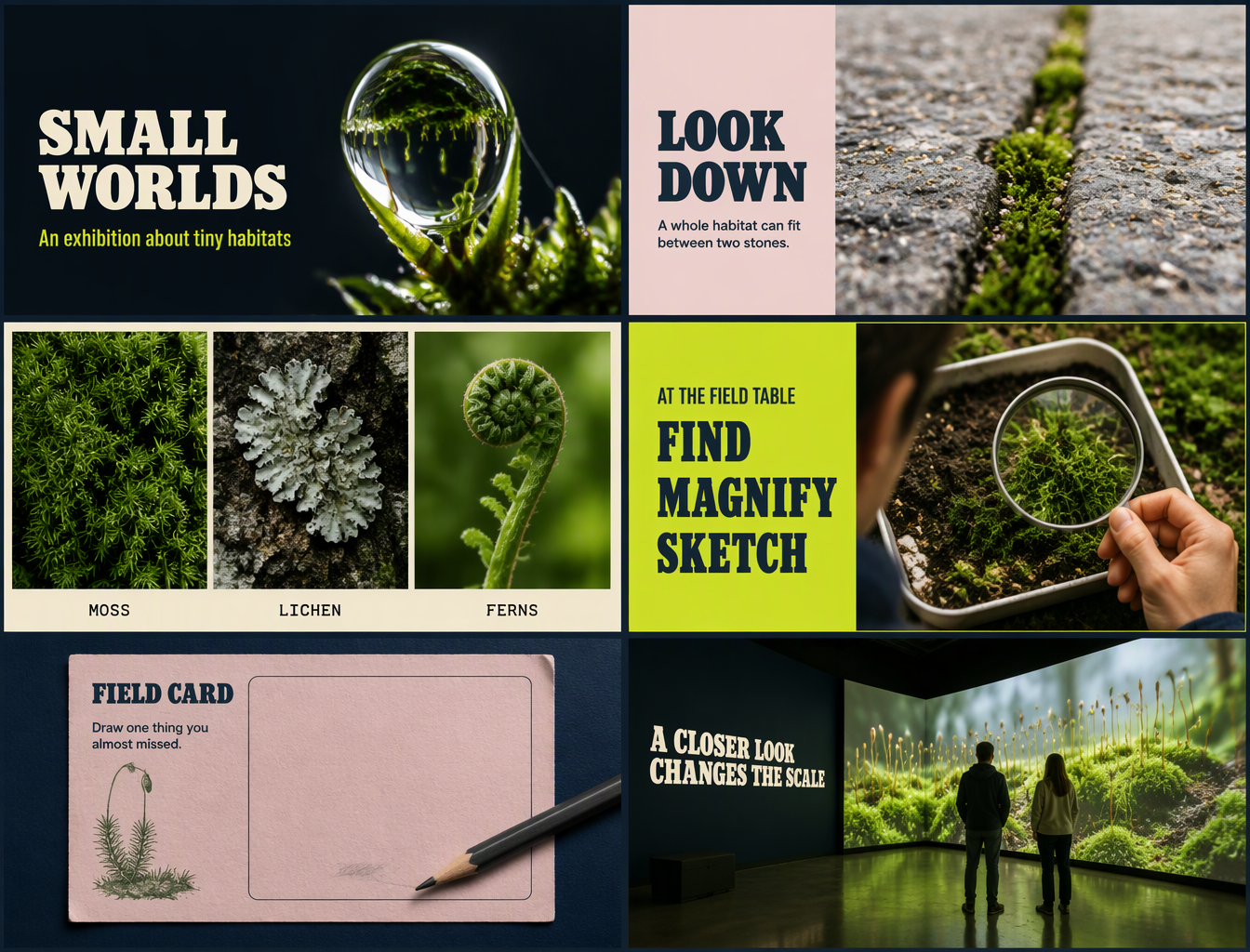
Create one landscape 4:3 presentation board for SMALL WORLDS, a fictional hands-on exhibition about miniature habitats. Arrange six complete 16:9 slides in two columns and three rows. Use straight-on, edge-to-edge slide artwork, even gutters, and muted ink-blue margins around the board. Each slide should have a distinct composition and a clear reading order.Build the visual identity around vivid moss green, blueberry ink, shell pink, and electric citron. Set major titles in a broad, heavy serif with rounded bracketed serifs. Use a highly legible sans serif for short descriptions and a compact monospaced face for specimen labels. Keep the presentation copy in English.Slide 1 · The coverPlace a single clear water droplet on the tip of a moss shoot, photographed from surface level with a macro lens. The drop fills much of the right half and shows a sharp, inverted reflection of tiny green stems. Make the nearest leaves luminous at their edges, with narrow shadows between them. Let the left half fall into deep blueberry ink for an oversized two-line title. Add the subtitle in citron.Exact text: SMALL WORLDS An exhibition about tiny habitatsSlide 2 · Where to lookUse a shell-pink background and a low street-level photograph of moss in the seam between two old paving stones. The image fills the right two-thirds. Use the left third for a strong title and a short line of copy. Let the pavement be recognizably ordinary, with chipped stone, pale grit, and one delicate line of moss in sharp focus.Exact text: LOOK DOWN A whole habitat can fit between two stones.Slide 3 · The specimensBuild three full-height photographic strips on a soft ivory slide. In the first strip, look down onto dense green moss shoots. In the second, shoot pale lichen tight against charcoal bark under grazing light. In the third, use an oblique macro view of a small fern uncurling, with its spiral emerging from a soft green background. Give each image one monospaced caption on a flush ivory strip. Let the visual differences between the three surfaces carry the slide.Exact text: MOSS LICHEN FERNSlide 4 · The visitor experienceUse a saturated citron background. Show a large documentary photograph taken over a visitor’s shoulder as they hold a simple magnifying lens above a shallow moss tray. Through the lens, show the same patch of moss enlarged, with its detail aligned to the surrounding specimen. Include the matte metal edge of the lens, dark soil in the tray, and natural creases in the visitor’s hand. Arrange the three verbs in a strong vertical stack beside the photograph.Exact text: AT THE FIELD TABLE FIND MAGNIFY SKETCHSlide 5 · The take-home field cardPhotograph a real shell-pink field card against dark blueberry paper, from directly overhead. Design the card with a large blank drawing box, a short printed instruction, and one small green engraving of a moss shoot in the margin. Place a blunt graphite pencil across the lower corner without covering the copy. Use raking light to show paper fibers, a fine graphite smudge, and the slightly compressed edge of the printed card.Exact text: FIELD CARD Draw one thing you almost missed.Slide 6 · The exhibitionFinish with a wide, floor-level photograph inside the gallery. Project one continuous image of a moss habitat across the back and right walls, letting the corner bend the landscape around the room. Include two visitors seen from behind to establish scale. Keep the left wall a quiet blueberry tone for the final line in large ivory serif type. Give the gallery a faint green reflection across its polished floor and a dark, uninterrupted ceiling above the images.Exact text: A CLOSER LOOK CHANGES THE SCALE.Render the specified English copy exactly. Keep all six slides legible as a single overview. Make the tactile details feel specific to each scene: wet moss, chipped stone, flaky bark, graphite, and projected light. Exclude extra copy, page numbers, logos, and watermarks.