



Back to GalleryGPT Image
Prompt
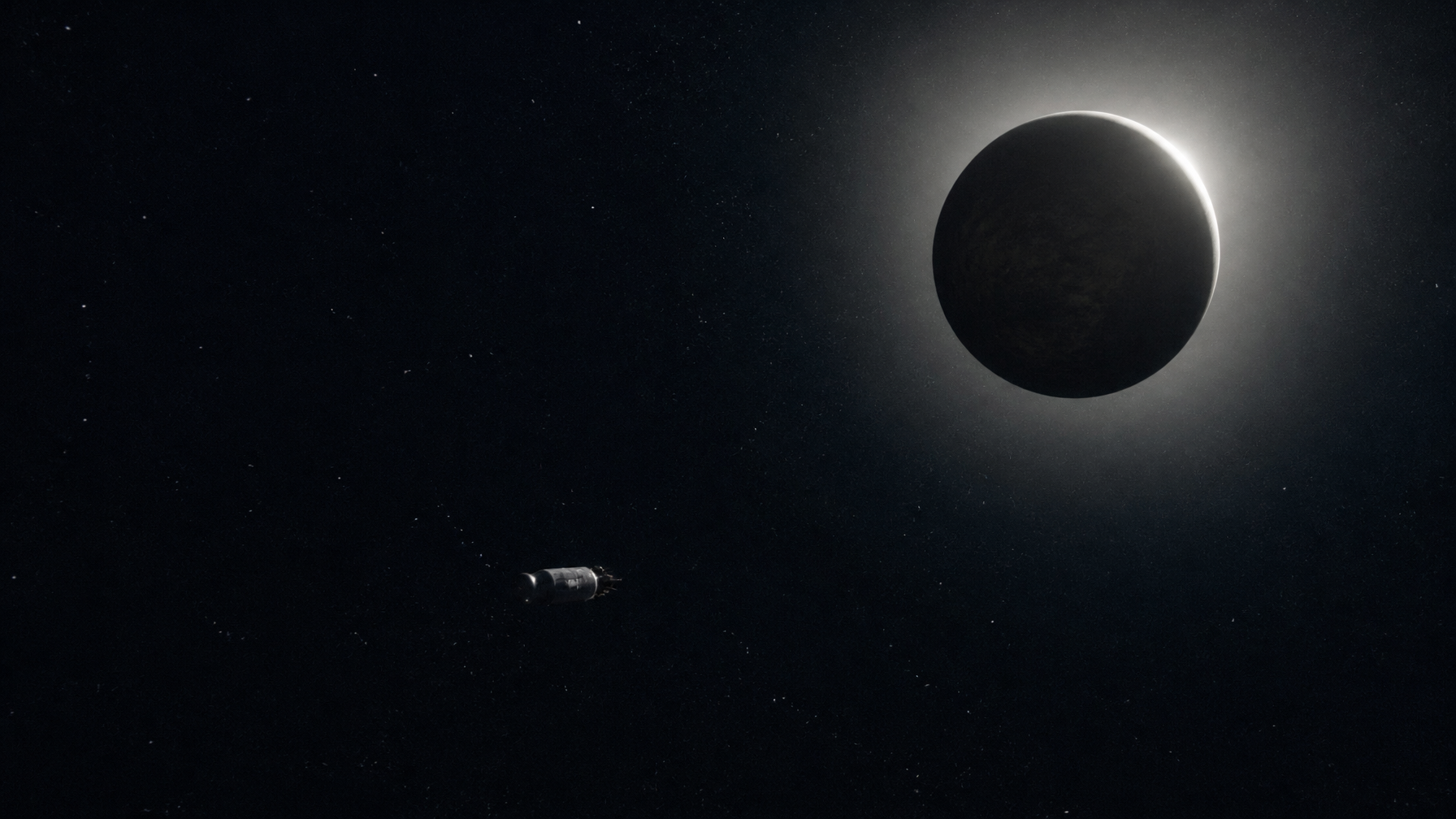
Photorealistic cinematic space scene, deep space exterior, 16:9 widescreen frame. Not an illustration, not a poster — a single still frame from a 1970s science fiction film. COMPOSITION. A vast empty starfield in near-black. In the upper right third, a large dark planet, a perfect sphere, roughly one fifth of the frame width, its centre sitting about a quarter of the way in from the right edge and a third of the way down from the top. In the lower centre-left, small and isolated, a tiny crewed spacecraft — roughly seven percent of the frame width — a blunt-nosed cylindrical capsule with a clustered engine section and small fins at the rear, drifting diagonally. The craft sits well below and to the left of the planet. Enormous empty negative space to the left and along the bottom. The visual diagonal runs from the craft up to the planet, lower-left to upper-right. PLANET. The planet is almost entirely in shadow — a dark near-black disc with only the faintest mottled texture of clouds and continents barely visible at eight to fourteen percent brightness, never fully black. A razor-thin crescent of pure blown-out white runs along its upper right limb, one or two pixels wide, marking the direction of the unseen sun. Around the entire disc, an enormous soft luminous halo blooms outward and upward and to the right, a broad diffuse grey-white glow fading over hundreds of pixels into the black, brightest adjacent to the crescent and dissolving gradually into the starfield. The halo is a soft continuous gradient, not a ring, not a lens flare artefact. LIGHTING. A single distant point source, the sun, positioned behind the planet, above and to the right of it, completely out of frame — the only light in the scene. Its rays are parallel and hard, producing a knife-edge terminator. No fill light, no bounce, no rim on anything except the planet's limb. The lower half of the frame is the darkest region, falling to four to seven percent brightness. The left edge is nearly black. SPACECRAFT. The craft reads against the void thanks to a narrow cheated frontal light from the camera side, upper left — a small polished-metal nose catching a tight specular highlight at eighty-five to ninety-five percent, a soft metallic sheen along the upper hull, and the entire underside crushed to near black with no detail. Panel lines, small greebles, antennae and a docking ring are barely legible at this scale. It looks like a physical miniature lit with a single snooted lamp, not a CG asset. STARFIELD. Uniform, sparse, thousands of single-pixel white stars of varying faintness, evenly scattered with no Milky Way band, no colour fringing, no twinkle, slightly soft. A handful of marginally brighter stars. Perfectly still. OPTICS AND RENDERING. Shot on a very long lens, the equivalent of two hundred millimetres, nearly orthographic — the planet is a geometrically perfect circle with no perspective distortion. Deep focus, f/11, everything sharp. Low macro contrast in the shadows, high contrast only at the crescent edge. Visible fine film grain across the whole frame, including the empty space, strongest in the dark midtones. A faint vignette in the corners. Blacks lifted to three to five percent, never true zero. Cool blue-grey split tone: shadows pushed toward desaturated navy, the glow neutral white with a faint cool tint, the dark side of the planet holding a whisper of warm olive in its cloud texture. Muted, quiet, awe-struck, vast, silent. Aspect ratio 16:9.