


![Character: [Adult Woman]](https://images.meigen.ai/cdn-cgi/image/format=auto,quality=85,width=640,fit=scale-down/tweets/2084204202486550946/0.jpg)

Back to GalleryGPT Image

431.9KOct 1, 2026
Prompt
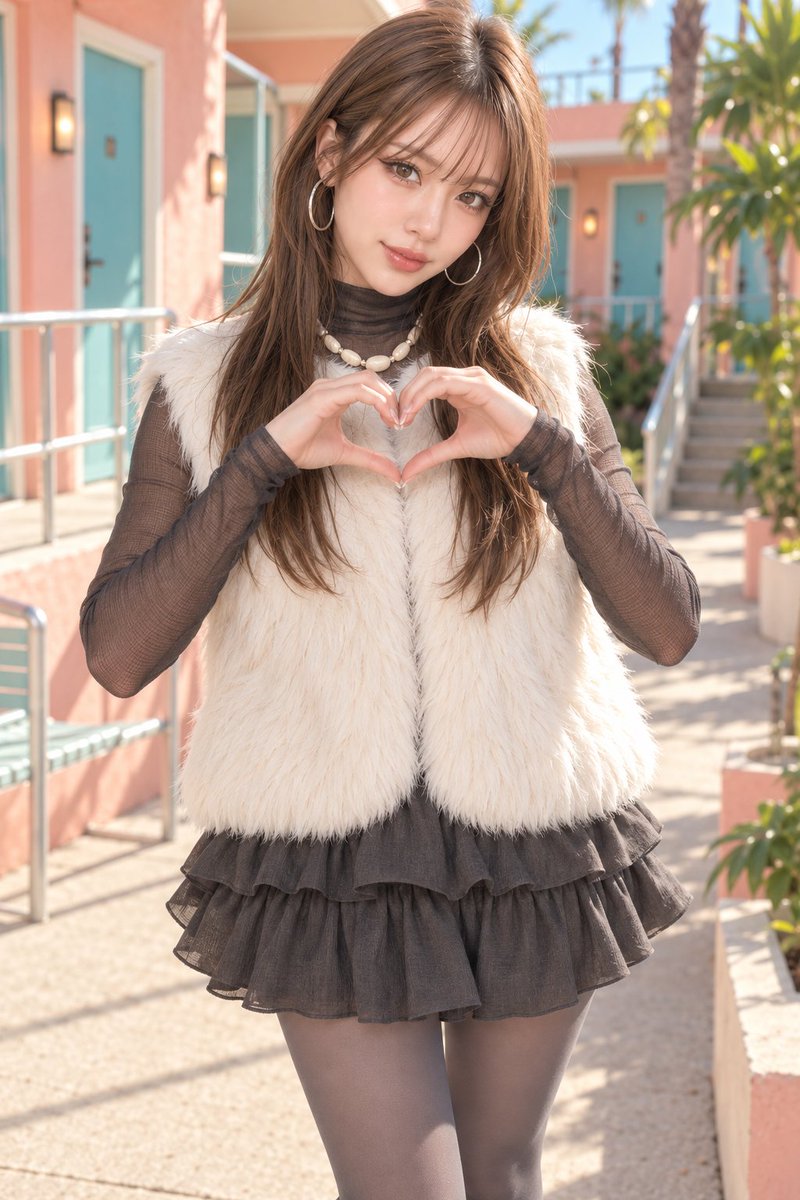
PROTECTED WARDROBE RULE — HIGHEST PRIORITY: Treat each garment description below as its immutable final product identity. Preserve construction, parts, hardware, material, pattern, and every registered graphic or marking—its surface, side, orientation, scale, colors, content, spelling, and count. FINAL WORN STATE overrides only the scoped item's use, position, side, orientation, fastening, layering, folds, tucks, knots, and drape. If source prose omits or misclassifies a component required by an explicit selection, that selection corrects only that component. A SOURCE GARMENT label describes the unstyled item, never the completed silhouette. Do not redesign, add, remove, mirror, duplicate, relocate, or redraw protected details. Wardrobe: Outerwear / layers: A hip-length sleeveless faux-fur vest in soft ivory white (#F2F0E9), with dense, fine, long wavy pile and a plush, slightly boxy body that flares gently toward the hem. Broad shoulders frame deep armholes, while a high rounded collarless neckline flows into thick center-front edges held edge-to-edge by concealed hook-and-eye fastenings. The front has softly rounded lower corners; the back is plain and full, and a smooth matching lining supports the shaggy shell. Final worn state: - Front closure: FINAL FASTENING STATE — Fasten every original front fastening. The front edges meet or overlap continuously throughout the original fastening run, with no open slit through that closed section. Engage each closed fastening with its matching eye or receiving loop; overlap alone is not fastening. Preserve source count, type, order, spacing, endpoints, and placket length, plus construction beyond both endpoints. Add, remove, or relocate no hardware; keep unrelated fastenings unchanged. Change only the selected registered state and leave every unselected component and connection unchanged. Crisp handling within this same operation: Keep the resolved primary closure mechanism and all its parts, count, and order unchanged. Keep the selected connected/disconnected position or zipper-segment map, every open or joined interval, and all endpoints unchanged. Closed positions or zipper segments remain physically joined; open ones remain disengaged. Keep unrelated closures in their source-defined states. Smooth only the surrounding fabric into clean, controlled panels with minimal incidental creasing. Top: A charcoal sheer stretch-mesh turtleneck top with a close-fitting body, fine smooth texture and a softly translucent finish. A tall double-layer collar hugs the neck and appears denser than the sheer chest and shoulders. Slim set-in sleeves extend over the wrists toward the bases of the hands, ending in narrow plain hems and allowing soft natural gathering. The matching sheer back and straight hip-length hem complete the simple pullover construction. Final worn state: - Tucking: Insert the complete hem circumference, including the front, both sides, and the back, into the actual waistband of the selected Bottom item at its selected worn height. Keep the complete hem continuously contained with no section hanging outside, and do not move the waistband vertically; let the selected finish control only the adjacent fabric distribution. Let material-correct tension travel through connected fabric and fade with geodesic distance; across seams, reduce or redirect it according to connection and stiffness, without a hard cutoff or unconnected jump. Keep unselected openings, edges, seams, closures, components, and connections topologically unchanged. Crisp handling within this same operation: Keep the selected tuck boundary clean and controlled, with even adjacent tension and only limited hem slack. Bottom: A high-waisted two-tier mini skirt in representative charcoal (#424242), cut from smooth matte woven fabric with enough body to hold a soft bell shape. A concealed elasticized pull-on waist supports a short continuous flounce around the hips; its edge ripples outward and curls into a gentle dip near the center front. Beneath it, a much deeper tier falls in generous vertical gathers and spreads to a wide thigh-high skirt with a narrow, softly wavy hem, continuing with the same fullness around the back. Legwear: Opaque footed tights in slate gray (#555764), made from smooth, fine, densely knitted stretch fabric with a subdued soft sheen and no pattern. A plain panty section and elastic waistband provide a fastening-free pull-on fit, with close-fitting legs continuing over the heels and insteps into closed toes. Footwear: A pair of jet black (#0A0C0D) patent-leather pumps with mirror-gloss uppers, elongated gently tapered square toes, low-cut rounded slip-on openings and closed heel counters. Thin black soles and low patent-covered block heels support the clean silhouette, with matching black leather lining. A fixed decorative warm silver (#C9C7BA) metal frame sits transversely across each vamp immediately ahead of the opening, spanning 85% of the vamp width; its broad polished rectangular plate surrounds a black patent-backed aperture about two-thirds as wide, edged by a raised rounded inner rim and a gently bowed lower border. These frames are ornaments, with no working buckle strap or instep fastening. Necklace: A short single-strand necklace of opaque pale warm ivory (#E5D7B3) beads, arranged in a shallow U across the collarbones. Softly faceted, flattened oval beads are largest at the center front and gradually shrink toward the nape, with a small round bead between each neighboring oval; a concealed flexible strand and discreet clasp close the graduated sequence at the back. Earrings: A pair of large silver-tone hoop earrings made from slender polished round-section tubing. Each hoop forms a clean circular loop with an open center and a discreet hinged post closure at the top.