![[DISH] captured at the exact millisecond of a dramatic liquid explosion, high-speed photography froz](https://images.meigen.ai/cdn-cgi/image/format=auto,quality=85,width=640,fit=scale-down/tweets/2030670376104087834/0.jpg)
![Create a hyper-realistic exploded vertical infographic composition of [FOOD].](https://images.meigen.ai/cdn-cgi/image/format=auto,quality=85,width=640,fit=scale-down/tweets/2010305720764551520/0.jpg)
Back to GalleryGPT Image

701.6KMay 4, 2026
Prompt
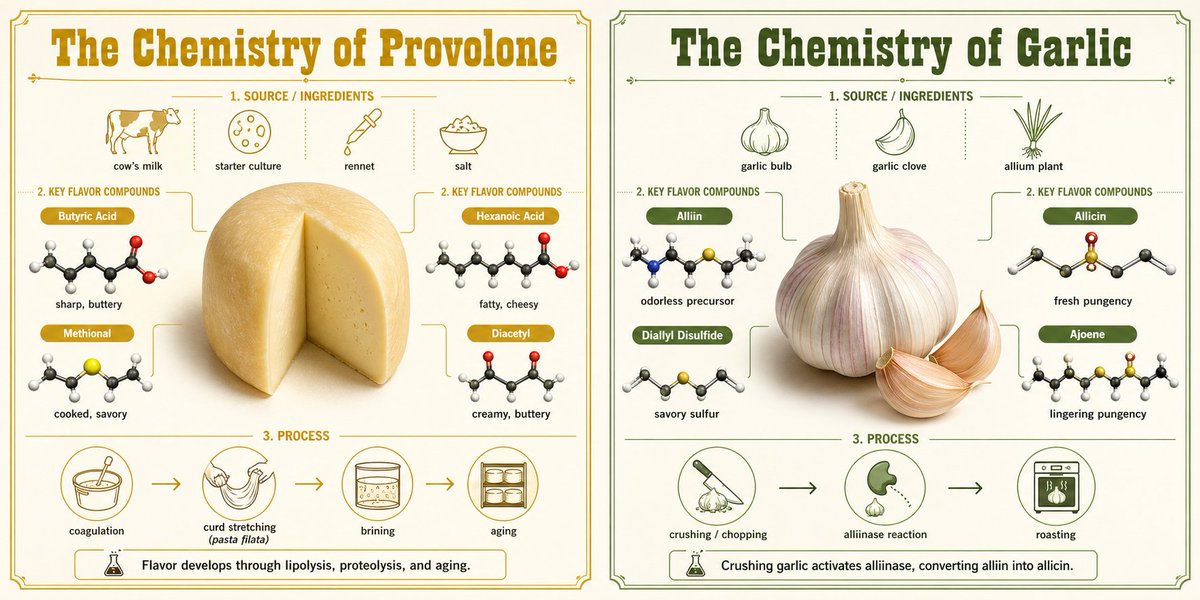
2x1 grid, Do this: Provolone & Garlic <instruction> 1. The Semantic Inference Engine (Chemical Deconstruction): Input A is a Product, Food, or Substance -> Analyze the subject to generate 3 Scientific Layers : The Ingredients (The Source): Identify the raw biological or mineral inputs. (e.g., Gin -> Juniper Berries, Coriander. Coffee -> Arabica Beans. Perfume -> Rose Petals). The Compounds (The Molecules): Identify the specific chemical structures responsible for flavor/effect. (e.g., Alpha-pinene, Caffeine, Ethanol, Salicylic Acid). The Process (The Method): Identify the manufacturing technique icons. (e.g., Distillation columns, Drip brewing, Cold pressing). 2. Container (The Science Poster): Goal: A "Chemistry of..." Educational Infographic. The Layout: Central Symmetry. The main subject anchors the middle; information radiates outward in organized columns or grids. The Header: Massive, bold Slab-Serif text at the top: "The Chemistry of [Input A]". The Background: Clean, matte Off-White or Pale Cream paper texture. 3. The Centerpiece (The Reality): The Object: A Hyper-Realistic Product Photography shot of Input A (e.g., A glass bottle, A steaming cup, A pill bottle). Placement: Vertical center. This is the only "Real" element in the image; everything else is illustration. 4. The Information Layer (The Vector Art): The Molecules: Ball-and-Stick Chemical Models (2D or 3D) floating near the ingredients. Labels: Each molecule has a small "pill-shaped" label with its scientific name (e.g., "Linalool"). The Icons: Flat, simple vector icons representing the "Source" (Leaves, Berries) and "Process" (Stills, Gears). The Text: Blocks of clean, legible sans-serif text explaining the function of each compound (e.g., "Aroma: Woody, Piney"). 5. Design Syntax (Color & Flow): Color Palette: Monochromatic + Black. Pick ONE accent color derived from the product (e.g., Green for Gin, Brown for Coffee) and use it for all headers, borders, and molecule bonds. Style: Textbook/Academic. Clean lines, generous whitespace, structured alignment. Output: ONE image, Vertical Aspect Ratio (3:4), Mixed Media (Photo + Vector Infographic), Clean and Educational. </instruction>